Docks, lifts, and seawalls on Cape Coral's canals
A planning guide for waterfront owners in Cape Coral and nearby Lee County: who issues the permit, how fresh and salt water change the rules, and what a dock project involves.
Tide ranges
- Cape Coral Bridge
- 1.14 ft
- NOAA station 8725451
- Fort Myers
- 1.32 ft
- NOAA station 8725520
- Matlacha Pass
- 1.82 ft
- NOAA station 8725506
- St. James City
- 2.40 ft
- NOAA station 8725393
Great diurnal range in feet, from mean lower low water to mean higher high water, on NOAA's 1983 to 2001 datum epoch. Source: NOAA CO-OPS tidal datums (opens in a new tab), retrieved .
Three questions about your lot
You can answer three questions about your own property before a contractor draws anything. The answers decide which office issues the permit, what goes in the application, and what the pilings and hardware have to withstand.
- Is the lot inside Cape Coral city limits? Inside the city, the City of Cape Coral issues dock permits through its Marine Improvement application. Pine Island, Matlacha, Bokeelia, and St. James City are unincorporated, so Lee County issues those permits. Fort Myers has its own building department.
- Is the canal fresh or salt water? The City's January 2026 dock guidelines ask for DEP approval only if the lot is not on fresh water. Salt water also changes what the wood and metal need.
- How much over-water area will the dock have? Florida law exempts a private dock of up to 1,000 square feet in an artificial canal from a state permit. In Outstanding Florida Waters such as Matlacha Pass, the limit is 500 square feet, and FDEP counts roofs and lift canopies toward it.
The water behind the house
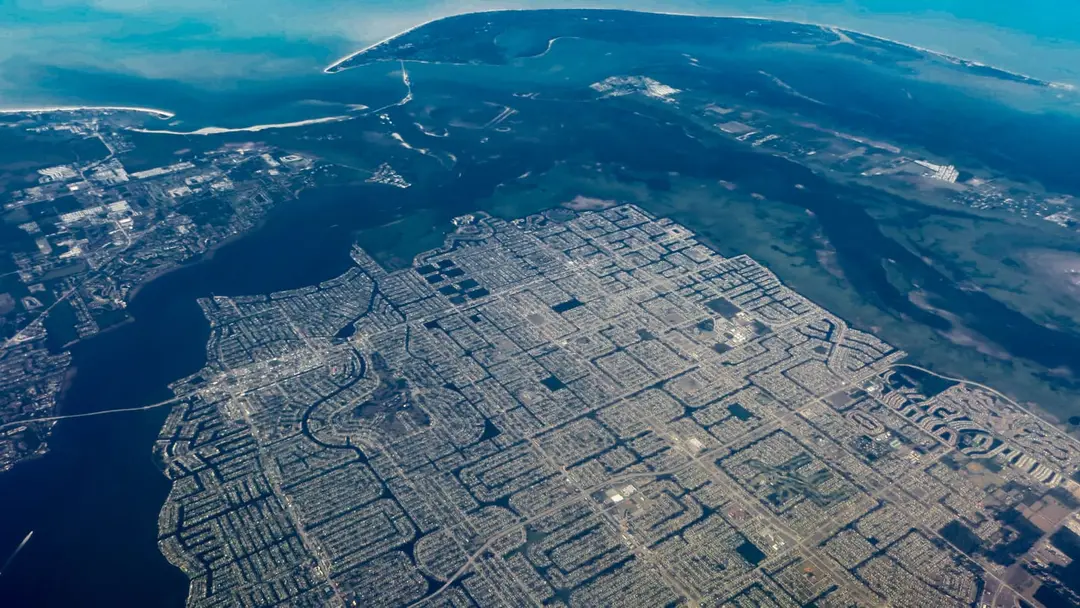
The City of Cape Coral describes its canal system as more than 400 miles long. The City's Waterfront Living Guide says the freshwater canals collect stormwater and hold it for slow release to the tidal canals, while runoff in saltwater areas goes straight to the tide.
The tide moves less than many new owners expect. NOAA's Cape Coral Bridge station on the Caloosahatchee records a great diurnal range of 1.14 feet. The range grows toward the Gulf: 1.82 feet at the Matlacha Pass station and 2.40 feet at St. James City. The canal types page has the station table and what it means for a lift.
Storm history and engineering
Hurricane Ian made landfall on Cayo Costa on September 28, 2022, as a category 4 hurricane. The National Hurricane Center's report puts the highest inundation at 6 to 9 feet above ground level in Pine Island, Cape Coral, and other communities near the mouth of the Caloosahatchee.
Ask early who engineers the dock, the lift, and any seawall work, and whether the drawings carry a Florida engineer's seal. For seawalls, the City also accepts plans that follow its approved Engineering Design Standards. The Florida Building Code 9th Edition takes effect December 31, 2026, so a permit filed late in the year may fall under the new edition.
Repair, replace, or rebuild
A worn dock may need less paperwork than you fear. The City's repair guideline says re-decking without replacing the frame or stringers does not need a permit. Replacing framing or pilings, or adding area, goes through the Marine Improvement application. At the state level, Fla. Stat. 403.813(1)(d) exempts a replacement dock built within 5 feet of the old location, no larger, and with no fill.
For new docks, lifts, and seawalls, the docks, lifts, and seawalls page covers the application package, materials, and what to ask a contractor. The planning guides go deeper on permits and list the statute or City document behind each rule, and the areas covered page shows which office handles each community.
Local waters
Water names in italic.
- Caloosahatchee RiverTidal river between Cape Coral and Fort Myers. NOAA's Cape Coral Bridge tide station sits on it.
- Matlacha Pass Aquatic PreserveState aquatic preserve designated in 1972, about 14,600 acres between Pine Island and Cape Coral, and designated an Outstanding Florida Water.
- Matlacha Historic DistrictLee County historic district designated in 1990, with design guidelines for new construction.
- Yacht Club Community ParkIts fishing pier was severely damaged by Hurricane Ian; the City is redeveloping the park in phases.
Freshwater and saltwater canals
| Freshwater canal | Saltwater canal | |
|---|---|---|
| DEP approval with a City dock application | Not required by the City's guidelines | Required by the City's guidelines |
| Seawall | Not required, per the City's Waterfront Living Guide | City seawall guideline asks for DEP approval or a federal general permit |
| How the water moves | Holds stormwater and releases it over time to the tidal canals | Tidal; runoff goes straight to the tide |
Freshwater canal
- DEP approval with a City dock application
- Not required by the City's guidelines
- Seawall
- Not required, per the City's Waterfront Living Guide
- How the water moves
- Holds stormwater and releases it over time to the tidal canals
Saltwater canal
- DEP approval with a City dock application
- Required by the City's guidelines
- Seawall
- City seawall guideline asks for DEP approval or a federal general permit
- How the water moves
- Tidal; runoff goes straight to the tide
Confirm the canal type for a specific lot with the City before design starts.
A canal dock and lift, in plan view
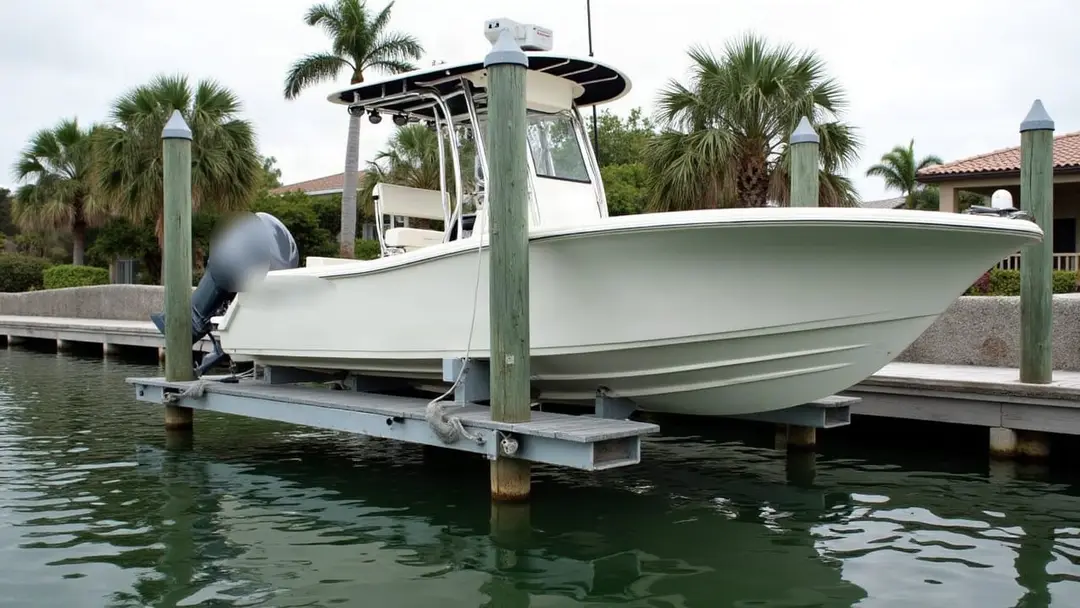
For the state exemption, the over-water area includes the decking, the platform, and any roof or lift canopy.

What to settle first
-
Fresh water or salt water
The City of Cape Coral's dock and boat lift guidelines ask for state DEP approval only if the lot is not on fresh water. Find out which kind of canal your lot is on before design starts.
-
City or county
Inside Cape Coral, the City issues dock permits through its Marine Improvement application. Pine Island, Matlacha, Bokeelia, and St. James City are unincorporated, so Lee County's Dock and Shoreline permit applies there instead.
-
Over-water area
Florida law exempts private docks of up to 1,000 square feet in artificial canals, and up to 500 square feet in Outstanding Florida Waters such as Matlacha Pass Aquatic Preserve. Roofs and boat lift canopies count toward that area.
-
Storm exposure
The National Hurricane Center reported 6 to 9 feet of storm-surge flooding above ground in parts of Cape Coral and Pine Island during Hurricane Ian in 2022. Ask whether a dock or seawall design is signed and sealed by a Florida engineer.
How a dock project usually runs
-
Confirm the waterway and the permitting office
Start with two questions about the lot: is the canal fresh or salt water, and is the property inside Cape Coral city limits? The answers decide which approvals the project needs and which office issues the permit.
-
Site plan and dock design
A City of Cape Coral dock application includes a site plan, a dock layout, and dock details. If the project includes a boat lift, the lift's engineering goes in the same package.
-
State and local approvals
On a saltwater lot, the City asks for DEP approval with the application. The City application is filed on its CSS portal by a contractor in one of the classes the City lists, or by an owner-builder. In unincorporated Lee County, contractors file a Dock and Shoreline permit through eConnect.
-
Pilings, framing, and decking
The contractor sets pilings, frames the dock, and lays the decking. In Cape Coral, wiring for a boat lift needs its own electrical permit, separate from the dock permit.
-
Inspections and closeout
City dock permits close with a Marine Final inspection, plus a stormpipe inspection where one applies. Lee County permits expire if no inspection passes within 180 days of issue.
Planning guides
These guides cover the questions that come up when you plan a dock, lift, or seawall in Cape Coral or nearby Lee County.
-
Cape Coral dock permits: which office, which application
Inside Cape Coral, the City issues dock permits, and DEP approval comes in only when the lot is not on fresh water. Outside the city, Lee County takes over.
-
Checking a dock contractor in Cape Coral and Lee County
Look the license up yourself, know which license classes the City and county accept, and get the scope, permits, and any warranty in writing.
-
Repairing or replacing a dock after a storm
Re-decking in Cape Coral needs no permit. Replacing framing or pilings does. Florida exempts a same-size replacement dock from a state permit if it stays within 5 feet of the original.
Common questions
Do I need a permit to build a dock in Cape Coral?
Yes. The City of Cape Coral, not Lee County, issues dock permits inside city limits. New wood docks, new concrete docks, and dock repairs, replacements, or additions all go through the City's Marine Improvement application on its CSS portal (guidelines revised January 2026). The City accepts applications from general, building, and residential contractors (CGC, CBC, CRC), from the marine specialty classes it lists, and from owner-builders. Private providers can't be used for these permits. If the lot is not on fresh water, the City also asks for DEP approval. A boat lift needs a separate electrical permit for its wiring.
Does replacing dock boards need a permit?
The City of Cape Coral's repair guideline (January 2026) says re-decking without replacing the frame or stringers does not need a permit. Replacing framing or pilings, or adding area, goes through the Marine Improvement application. At the state level, Fla. Stat. 403.813(1)(d) exempts repair or replacement of a dock within 5 feet of the same location, no larger than before, with no fill and no added permanent impact.
How big can a dock be without a state permit?
Under Fla. Stat. 403.813, a private dock of up to 1,000 square feet of over-water surface is exempt in artificial canals and outside Outstanding Florida Waters. In Outstanding Florida Waters, such as Matlacha Pass Aquatic Preserve, the limit is 500 square feet. FDEP counts roofs, boat lift canopies, and elevated platforms as well as decking toward that area. The state exemption doesn't replace local rules: the City or County sets how far a dock can extend into the waterway and how close it can sit to the side lot lines, so check those with the permitting office.
What's the difference between a freshwater and a saltwater canal for a dock?
On a freshwater canal in Cape Coral, the City's dock guidelines don't require DEP approval, and the City's Waterfront Living Guide says seawalls are not required. Freshwater canals hold stormwater and release it gradually to the tidal canals. On a saltwater canal, the City asks for DEP approval, and the wood and hardware sit in salt water. Gulf access, bridge clearance for sailboats, and depth along the route vary lot by lot, so check the route from your own dock rather than relying on a neighborhood's reputation.
How much does the tide move on Cape Coral canals?
Less than many people expect. At NOAA's Cape Coral Bridge station (8725451), the mean tide range is 0.82 feet and the great diurnal range is 1.14 feet. Ranges grow toward the Gulf: the Matlacha Pass station reads 1.82 feet and St. James City on Pine Island 2.40 feet (great diurnal range, 1983 to 2001 datum epoch).
Who permits docks on Pine Island, Matlacha, Bokeelia, and St. James City?
Lee County. These communities are unincorporated, so a dock, lift, or seawall needs a Lee County Dock and Shoreline permit, which contractors file through eConnect. The contractor needs a state license registered with Lee County or a Lee County certificate of competency. Parcels with more than two boat slips must meet the county's Manatee Protection Plan siting criteria, and docks longer than 200 feet need a benthic survey. As an Outstanding Florida Water, Matlacha Pass Aquatic Preserve has a 500-square-foot exemption limit, and because it is an aquatic preserve, FDEP's online self-certification is not available.
How do I check a dock contractor's license in Florida?
Search the contractor's name or license number at MyFloridaLicense.com, and for a company, check the individual qualifier too. Florida repealed its state Marine Specialty Contractor rule (61G4-15.033) in May 2024. The City of Cape Coral lists marine specialty classes among the applicants it accepts, and Lee County requires a state license registered with the county or a county certificate of competency. Ask any contractor for proof of insurance, and get the scope of work in writing.
Can I build my own dock as an owner-builder?
The City of Cape Coral accepts owner-builder dock applications with an Owner/Builder Affidavit. Under Fla. Stat. 489.103(7), the owner must personally supervise the work, appear in person to sign the permit application, and sign a disclosure statement. If the property is sold or leased within one year of completion, the law presumes the work was done for sale or lease.
Which building code applies to a dock permit?
The Florida Building Code 8th Edition (2023) is in force now. The 9th Edition takes effect on December 31, 2026, according to the Florida Building Commission. If a permit application will land near that date, ask the contractor which edition the plans are drawn to.
What happens when I send a request through this site?
Your request goes to an independent local contractor who works on docks, lifts, or seawalls in the area. That contractor may call or text you about the project and may pay for the referral. Cape Coral Docks does not perform construction work and does not set prices.
Planning a dock, lift, or seawall?
Describe your waterfront and the project. Your request goes to an independent local contractor, who may call or text you about it.
Areas covered: Cape Coral, FL, Fort Myers, FL, Pine Island, FL, Matlacha, FL, Bokeelia, FL, St. James City, FL.